Chapters
A Chance to Help
There’s a line in Grease where Principal McGee says, “If you can’t be an athlete, be an athletic supporter.” I’ve always loved it. It captures how I feel about my career in music marketing: helping artists and finding ways to support what they do.
Watch the Grease line
Grease (1978) · Principal McGee, played by Eve Arden. From Paramount Movies’ official upload.
Watch at the source · about 0:31I didn’t grow up thinking I’d have a creative life like the one I’ve had. I got a start in the music business hanging posters in record stores and moved into sales. I loved working with artists and being part of a business focused on raising awareness. I kept reading and thinking about what connects musicians and fans.
As I moved from sales into marketing, I started recognizing that I could have ideas, shepherd them and help artists. I came to MTV to create compilation CDs and work on movie soundtracks. That grew into working with advertisers and connecting programming with sponsorship. Finding myself in a position to think bigger was exciting.
MTV Advance Warning became the project I enjoyed most and am proudest of. We took a small monthly show about new artists around the world with McDonald’s. But it started with the work I was already doing at MTV, and a chance to help artists in a different way.
I occasionally met with Van Toffler, president of MTV, MTV2 and MTV Films, to update him on our soundtracks and CDs. Van was the biggest music fan of them all.
One project was a low-price new-music mixtape CD series for MTV.com. With fewer hours devoted to music videos, we needed other ways to introduce artists and give them MTV’s stamp of approval. I met with Tom Calderone, EVP of Music and Talent, before approaching his team, and was now working with his department to launch it.
I was also working with Ad Sales on branded custom CDs that could be sold or given away outside the usual CD channels. I wanted to grow awareness of new artists and develop revenue.
During my CD update with Van, Tom called with feedback from record-label presidents about MTV’s Big Ten rotation, introduced a few months earlier. Their complaint was that there wasn’t a place focused on new artists. Tom and Van discussed how to answer that. Van mentioned the mixtape project, and we were given the green light to create a 30-minute new-artist television show.
The CDs could introduce the music; the show could introduce the artists and let them tell their stories.
Two Copies, One Warning
I think we made five volumes. Each included a second disc, a Word of Mouth CD, to give to a friend without giving up your own copy. I got the labels to waive fees on that second disc by guaranteeing no more than 5,000.
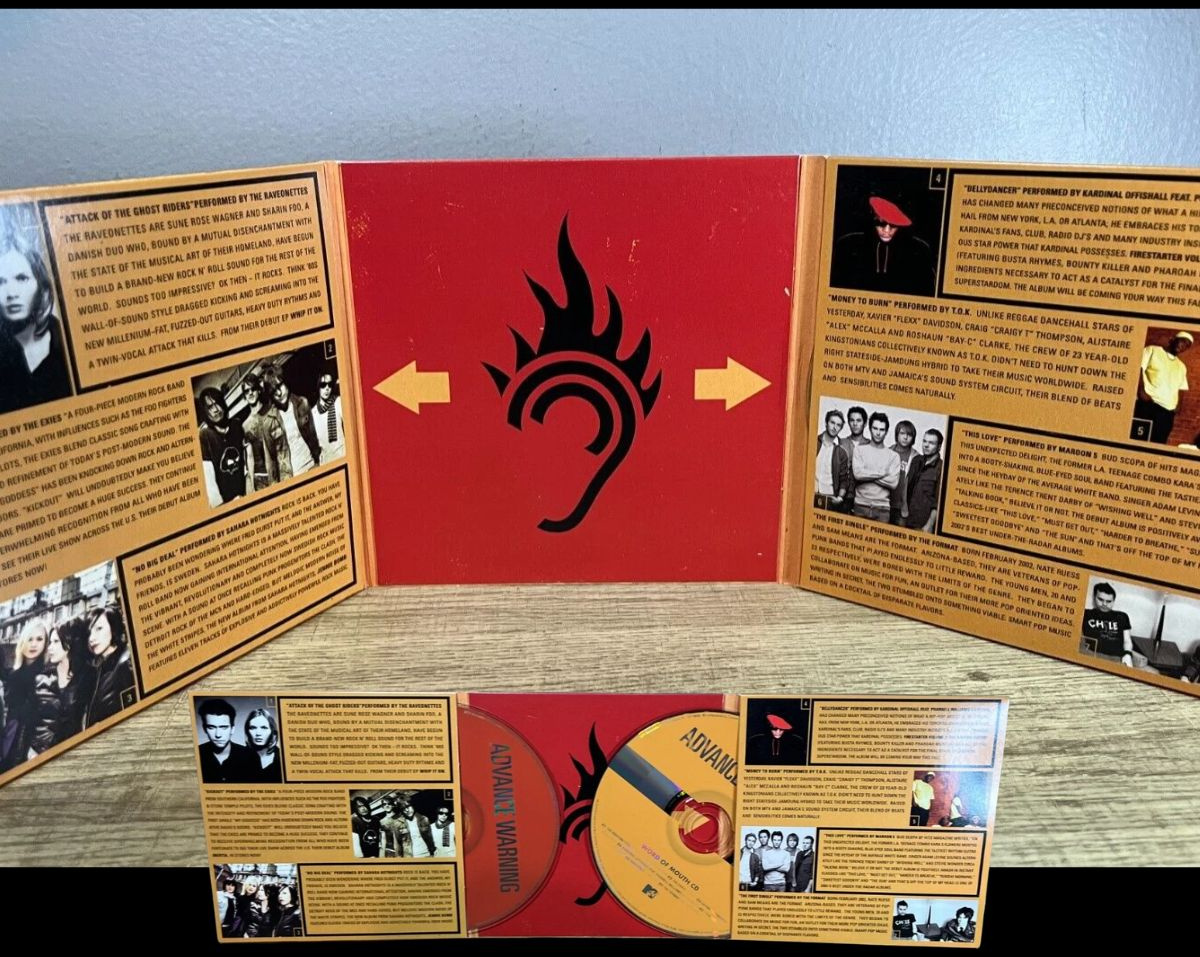
Word of Mouth: one copy to keep, one to share. Design by Thomas Berger.
The packaging & Dunkin’ connectionI was okay with low guarantees. The CDs showed the breadth of the brand, and I was having fun trying things. They didn’t sell much. We did a small Best Buy exclusive, too, but I eventually found a better use for the stock.
I was working on Jackass and loved its opening warning. With MTV moving away from music, I liked the irony of warning viewers about new music.
Warning was my contribution. In a meeting with the music team, my partners on the series, I said the name needed to explain the show immediately: we were a fill-in show, and viewers might not know what they’d tuned into. Brandon Schmidt brought up a series from a British music magazine. We combined that reference with Warning and chose Advance Warning. The name told you we were introducing artists you might be hearing more about.
It Just Showed Up
We made one episode a month, generally profiling four artists. Labels vied for those four or five places, but we had no regular time slot. Each episode ran four or five times without promotion. Sometimes it made TV Guide; sometimes it didn’t. It just showed up.
There was no Twitter. I knew the labels wanted their artists on it, but had little understanding of whether viewers knew the show.
Kelly DeLace, a producer from MTV who joined the group, was key to every episode. She and Jillian Haubert shot and edited interviews, intercutting label footage. Many artists had little material yet, so they were making profiles, not just assembling finished videos.
Jim Shearer was the perfect host. Watching Jack Coyne on Track Star today reminds me of him. Jim later hosted at SiriusXM, too. His introductions helped viewers get to know the artists alongside the interviews and music.
Watch a surviving 2003 program
A program-length survivor: Val Emmich, Dwele and Ima Robot
Watch at the sourceAfter the green light, I worked with Ad Sales Marketing on television integrations. I remember Sony PlayStation as our first sponsor: Jim talked about a game release, and we showed game footage to acknowledge the sponsor. The show was never highly rated or promoted. Keeping it going was a hustle, and sponsorship helped pay for episodes.
I also created an Advance Warning radio show for American Airlines flights, and we extended the show to MTV XM Radio—more ways to introduce new music.
Why McDonald’s?
Brad Schwartz from MTV’s International division was sitting in my office one day and asked who my ideal partner would be. I said McDonald’s.
I’d been a PolyGram Group Distribution sales rep in Boston when McDonald’s ran its 1994 Capitol/EMI music promotion with Garth Brooks, Elton John, Tina Turner and Roxette. I didn’t like that it helped superstars who didn’t need it, but the reach outside music retail interested me. Around our pitch, McDonald’s had more than 31,000 restaurants worldwide. I saw windows, storefronts and foot traffic that could introduce new artists.
Brad arranged a pitch in Chicago later that year through MTV International. I wanted McDonald’s to meet an artist, not just hear me describe one, so I flew Val Emmich from a tour stop in Grand Rapids, Michigan, to open with a few songs. The meeting was at nine in the morning—a tough audience and hour for a musician. Val was great.
A friend had introduced me to Val, a New Jersey artist we profiled on the show. He was signed to Columbia, though I never felt they gave him his shot. He kept going: acting, including playing Liz Lemon’s boyfriend on 30 Rock, making music and videos, and writing books. I liked putting someone from the show in front of the people we were asking to support it.
Each of the 50 people in the room got all five CD volumes plus three CDs of brand-new music as a leave-behind. They didn’t know how many I had because we hadn’t sold much. Nobody asked for numbers.
The more they could take away and try, the longer they might think about the show. They could listen after I was gone, and Word of Mouth gave them a way to share it beyond the meeting.
I played an artist highlight reel with sales before and after the show on screen. I wasn’t taking credit for those sales or claiming we’d made their careers, but I didn’t think the pattern was a coincidence. It was part of my case for introducing new artists through MTV.
A Global Idea, Locally
I called my friend Mary Russell, who brought in Dean Lubensky. They’d been part of VH1’s creative team, and I was lucky to get their design support at such short notice. In 48 hours, they created visuals and large presentation boards that brought the pitch to life.
We built a live concert series into the proposal and talked about local talent contests, ways the restaurants could incorporate music, and custom merchandise. Each territory could feature its own artists within a global new-music platform, rather than use exactly the same music as the U.S. A local artist didn’t have to be one we were featuring at home. Local activities could give people a reason to participate; the show connected them.
The CDs had become part of a bigger idea: music people could take home, profiles that introduced the artists, and the live performance we’d brought into the room. McDonald’s bought the sponsorship, and the show had a way to keep going.
The People Who Made It
I left MTV in spring 2005 and stopped working on Advance Warning. I consulted for MTV Films for the next year, separately from the show. Advance Warning stayed on the air in the U.S. through the rest of 2005 as part of the McDonald’s deal, then ended. It lasted longer internationally, though I still don’t have a clear picture of how long each version held on.
I wish I’d been in a position to keep building it from there. My time at MTV had ended, and with so many people involved, I wasn’t in a position to drive what came next.
Years later, I found a discussion on Reddit where people were looking for old episodes and talking about artists we’d featured. It was nice to see the show remembered after all that time.
Tom and Amy Doyle were great partners on the soundtracks and compilation CDs. Holly Schomann worked with me on MTV Handpicked 1 and 2, Justin Prager on Headbangers Ball 1 and 2, and Amy on Tough Enough. I also met with David Cohn at MTV2 about various projects. There was so much music knowledge around me, and I liked finding things we could make together.
Brad later helped launch and lead MTV Canada, became president of Pop TV and eventually The CW, and helped bring Schitt’s Creek to American audiences at Pop.
I also want to remember Tuma Basa, Buttahman, Yomi Desalu, Robyn Hopkins, Jennie Rossello, Courtney Smith and Perry Turcotte. I liked working with people willing to try an idea. Kelly, Jillian and Jim were essential to the episodes people saw. I’m probably forgetting someone, and I’m sorry if I’ve left you out.
The profiles stayed with me when I went to Warner Bros. Records. Labels could tell their own artists’ stories and bring sponsors into that work, and I wanted to try it there. Advance Warning showed me what we could do even when an artist had little footage or no place in regular video rotation.
What I loved was helping new artists with people who cared about the music. Every month, we could give roughly four artists MTV’s stamp of approval and room to tell their stories. That’s what I’m proud of when I think about the show.
The archive.
The artists, surviving recordings, packaging and press behind the story.
Enter the archive